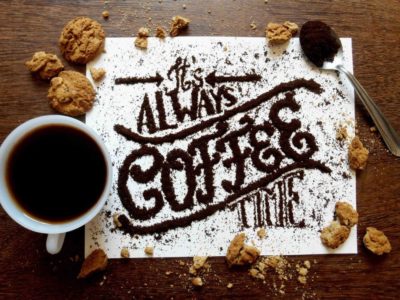

I’ll never forget my first day as a Starbucks barista. I remember tying my apron for the first time, excited and terrified at the prospect of serving the never-ending line of coffee enthusiasts. I imagined myself several weeks in the future, once I’d mastered every drink, exuding confidence and capable of carrying intellectual conversation about fair-trade beans while simultaneously perfecting their soy, half-caf, six Splenda, grande, sugar-free caramel macchiato. As far as I was concerned, this job wasn’t just about coffee, it was a lifestyle.
Mock me all you want, I’m just being real. As a writer and avid YA literature enthusiast, coffee is central to the common “aesthetic” of all things hip. Personally, I find it hard to write without it—even when fully alert. I may have even, dare I say, developed a dependency of sorts. And I’m not the only one.
According to the Behavioral Pharmacology Research Unit at John Hopkins Medicine, it’s estimated that between 80 and 90 percent of North American adults and children habitually consume caffeine.
We’ve all been warned of the dangers. Caffeine is a drug! Caffeine causes sleep disorders! Caffeine causes high blood pressure! I hear these these sayings often, especially from more health-conscious peers. It’s not that I ignore them, it’s just that their self-assured, fire and brimstone approach reminds of the gym coach from Mean Girls (Don’t drink coffee. You will get pregnant and die.). Technically, they’re all correct, but these standalone statements should be taken with a grain of salt—or sugar, if you will.
Studies show that consuming 30 milligrams of caffeine per day can affect typical behavior and cause mood swings; 100 milligrams per day can result in physical dependence and withdrawal symptoms upon abstinence. In the same study by Johns Hopkins, the average per capita daily caffeine intake by adults is 280 milligrams (about 17 ounces of drip-coffee), so it’s no wonder this is a hot-button issue.
However, I wouldn’t alter your morning routine just yet. No studies have proven caffeine produces any significant life-threatening health risks. Colloquially, we refer to our need as an addiction. But according to the World Health Organization, even extraordinary caffeine consumption isn’t enough to classify it as “addictive,” rather, as causing a dependency, which is less severe and more easily treatable. So onward friends, continue to drizzle your way to a more successful you.
As college students, we thrive on caffeine. There are currently four Starbucks’ on my campus, the University of Florida, alone. It’s borderline criminal the way they’re freaking everywhere, luring us in with their overpriced frappuccinos and minimalist red cups.
No, this isn’t my subversive way of “sticking it” to the company I worked for. I loved my time as a barista. I loved the atmosphere, the smells, learning the drinks and the history behind them all. But what I loved most of was that I could make people happy just by this one small thing: Getting their drink exactly right.
I can’t count the number of times a customer arrived, haughty and expecting me to fail. By some miracle, I figured out the exact number of white mocha pumps necessary to balance out their insane request for a quad-espresso. Boom. Their distaste would instantly turn to gratitude and yeah, I loved the hell out of that. If anything, I felt validated. I’m a writer after all, and I told all my friends, “Oh I practically live at coffee shops,” right as I adjust my infinity scarf and continue clicking away on my Mac, complete with a “Giving Tree” decal.
In a way, it was never just about coffee, it was about everything that went with it: the dimly lit, new-age, “good vibes” playlist that was my life. Clichéd? Very. Did I care? Absolutely not.
So maybe coffee isn’t all it’s cracked up to be. It’s only a drink, and what’s in a drink? A beverage that which we call by any other name would taste just as bitter. Organizations like Starbucks garner criticism for mass-producing such a fine product, tainting it with corporate greed and removing the “soul” from its robust body.
To that sentiment, I say frankly that I don’t give a damn. I never understand why people are so insistent on force-feeding their political agendas to anyone within earshot. The thought seriously makes me so tired I could pass out mid-sentence. Good thing I’ve got a pick-me-up right here. Take a stab at what I’m drinking. Go on. Guess.